
Tools
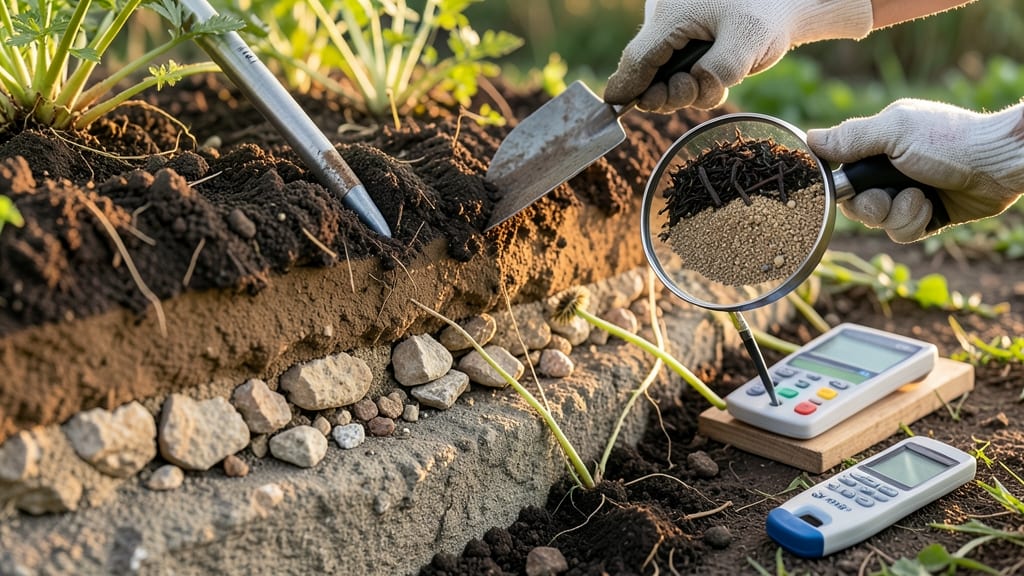
Understanding garden soil layers—known as horizons—reveals how they develop through natural processes like decomposition, weathering, and mineral movement, each serving distinct functions for root systems, nutrient cycling, and water management.
These distinct layers—often labeled O, A, E, B, C, and R—act like a living ecosystem where organic matter breaks down in the top layers while minerals accumulate deeper down. 🌱 The topsoil (A horizon) is where most plant roots thrive, packed with decomposed plant material and microorganisms, while the subsoil (B horizon) stores essential minerals like iron and clay that roots access as they grow deeper.
Each layer's composition directly impacts what plants can grow successfully in your garden.
For example, the O horizon's rich humus provides immediate nutrients, while the B horizon's dense mineral content supports long-term root stability. Understanding these layers helps gardeners make smarter decisions about composting, drainage, and plant selection—especially for deep-rooted vegetables or shallow flowering plants.
💡 In This Article
- How Soil Horizons Develop Naturally
- Optimizing Soil Layers for Plant Growth
How soil horizons develop naturally
The formation of soil horizons is a slow, multi-step process driven by both biological and geological forces. At the surface, organic matter like fallen leaves, grass clippings, and plant debris accumulates in the O horizon, where microorganisms break it down into humus—a dark, nutrient-rich material.
This decomposition process can take decades, especially in cooler climates where microbial activity slows to 1-2 millimeters per year during active seasons. The resulting humus not only feeds plants but also improves soil structure by binding particles together, creating pore spaces that hold air and water.
Below the O horizon lies the A horizon, often called topsoil, where mineral particles mix with decomposed organic material. This layer forms through a combination of weathering—where rocks break down into finer particles—and biological activity from earthworms and fungi.
For instance, a single earthworm can process up to 500 pounds of soil per year, accelerating nutrient cycling. Meanwhile, the E horizon, found in forested areas, undergoes leaching—where water carries dissolved minerals downward, leaving behind a lighter, sandier layer that often appears bleached.
This process highlights how water acts as nature's plumber, redistributing nutrients across the soil profile.
Deeper still, the B horizon (subsoil) accumulates minerals like iron, aluminum, and clay that were leached from above. These minerals often form hardpan layers, which can restrict root growth if too dense.
The C horizon consists of partially weathered parent material, like fractured bedrock or glacial till, while the R horizon is unweathered bedrock.
For example, in a temperate forest, the B horizon might contain 15-25% clay content, which helps retain water but can become compacted under heavy machinery or foot traffic.
What most gardeners don't realize is how climate influences these layers. In arid regions, organic matter decomposes more slowly due to lower moisture, while tropical soils may lack distinct horizons because heavy rainfall washes nutrients away faster than they accumulate.
The O horizon in a rainforest might be just 1-2 inches thick, whereas in a temperate garden, it could reach 3-6 inches with proper mulching. Understanding these variations helps explain why some plants thrive in one region but struggle in another.
Each horizon also hosts specialized microbial communities. The A horizon, for instance, contains 10,000 to 100,000 bacteria per gram of soil, while deeper layers have fewer but more specialized organisms that break down tougher minerals.
These microbes create a feedback loop: as they decompose organic matter, they release nutrients that fuel plant growth, which in turn provides more organic material for decomposition. This dynamic system is why healthy soil teems with life—literally millions of organisms working together beneath your feet.
To visualize this, imagine a cross-section of soil like a layered cake: the top layers are rich and dark (organic), while the bottom layers are denser and mineral-heavy. This stratification ensures plants have access to both immediate nutrients and long-term stability.
For example, carrots with deep roots benefit from the B horizon's mineral content, while shallow herbs like basil rely on the nutrient-rich A horizon. The interplay between these layers is what makes soil a living, evolving system rather than just dirt. 🌱