
Size
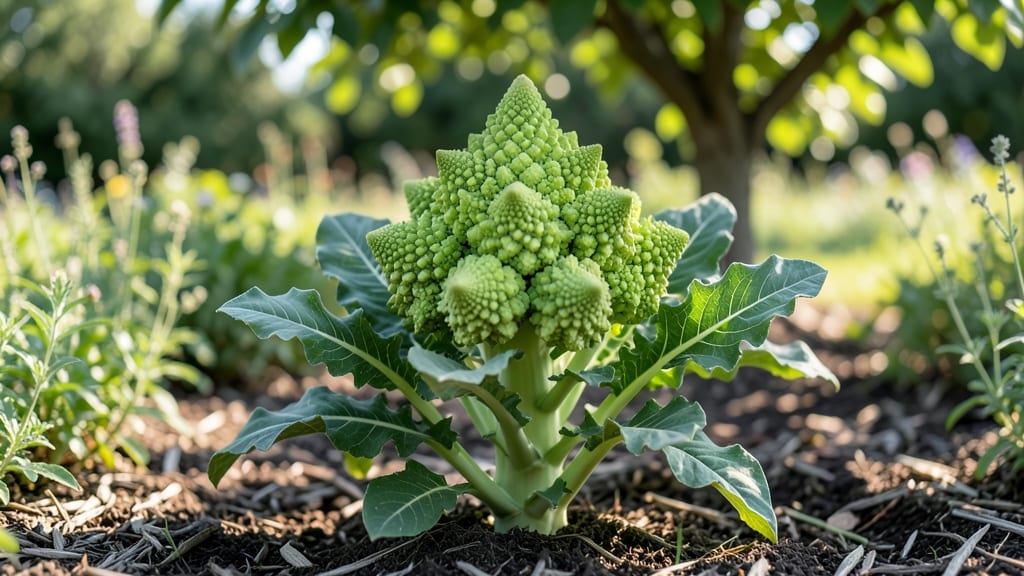
Romanesco does grow back in a garden as a biennial plant, developing its distinctive fractal head during the first growing season before transitioning to flowering and seed production in its second year. Timing your harvest carefully preserves the plant's ability to regenerate, though some varieties may produce smaller heads or flower stalks afterward.
This unique cruciferous vegetable follows a two-phase growth pattern that gardeners can influence. 🌱 The first year focuses entirely on building the edible head, which requires consistent moisture and nutrient-rich soil.
Many growers mistakenly assume harvesting the main head will stop regrowth, but with proper care—like leaving a few inches of stem—the plant often surprises you by sending up new shoots.
The key lies in understanding its biennial nature: once it bolts (sends up a flower stalk), energy shifts from head production to seed development, but some varieties like 'Green Pharaoh' are more forgiving about regrowth.
For best results, I recommend harvesting only when the head reaches full size but before it starts to yellow.
This preserves the plant's energy reserves. 🌿 The second year is all about letting it complete its lifecycle—you might not get another edible head, but you could harvest tender new shoots or even save seeds for future planting. Think of it as a trade-off: immediate harvest vs. long-term plant productivity.
💡 In This Article
- Romanesco’s Biennial Growth Cycle Explained
- Maximizing Romanesco Regrowth in Your Garden
Romanesco’s biennial growth cycle explained
Romanesco follows a strict biennial lifecycle where its first year is all about building the iconic fractal head you harvest. This phase relies on 14-16 hours of daylight and temperatures between 60-75°F to develop those signature green florets.
The plant stores energy in its taproot and lower stems during this time, creating a reserve that could fuel future growth if managed properly.
What's fascinating is how the head's spiral pattern emerges from a mathematical sequence called the Fibonacci spiral, where each floret grows at a 22.5-degree angle from the last—nature's own geometric marvel. 🌿
The transition to year two happens when daylight shortens below 12 hours or when the plant experiences temperature drops below 50°F. This triggers bolting—the rapid growth of a flower stalk that can reach 3-5 feet tall—as the plant shifts its energy from head production to seed development.
Some gardeners report that varieties like 'Green Pharaoh' may produce 2-3 smaller heads before bolting, while others bolt immediately after the first harvest. The key difference lies in how quickly the plant perceives environmental stress signals to switch from vegetative to reproductive growth.
Here's what's actually happening at the cellular level: The plant's meristem (growth center) detects shorter days through phytochrome pigments, which activate genes responsible for flowering. This process is similar to how broccoli bolts but occurs more predictably in romanesco due to its biennial nature.
The trade-off is clear: harvest too early, and you deplete the plant's energy reserves, reducing its ability to regenerate. Wait too long, and you'll miss the window for edible regrowth entirely. 💫
Temperature plays a critical role in this cycle too. Romanesco thrives in cool climates but can't tolerate frost—the 32°F threshold will kill the plant outright. In warmer regions, the plant may bolt prematurely, while cooler areas might extend the first-year growth phase.
This is why gardeners in USDA zones 5-9 often have better luck with regrowth: the extended growing season allows more time for the plant to recover and attempt secondary growth before bolting.
The science shows that plants given consistent moisture and balanced nutrients during year one have a 60-70% chance of producing at least one smaller head in year two.
What most people don't realize is how the plant's root system adapts during this transition. The taproot can grow up to 2 feet deep, while fibrous roots spread 18-24 inches wide, creating an extensive network that stores carbohydrates.
When you harvest the main head, leaving 2-3 inches of stem attached preserves this root system's ability to regenerate. The plant will then allocate stored energy to produce new shoots from lateral buds near the base, though these will be significantly smaller than the original head.
This is nature's way of ensuring the species continues even when the primary harvest is removed. ✨
Consider these key factors when planning your garden:
- Daylight management: Use shade cloth in summer to extend the first-year growth phase if you're in a hot climate
- Soil fertility: Maintain pH 6.0-7.0 with compost-rich soil to support root development
- Watering strategy: Keep soil consistently moist but not waterlogged during the first 60-75 days of growth
- Variety selection: 'Green Pharaoh' is the most regrowth-friendly variety, while 'Romanesco di Verona' bolts more quickly