
Tools
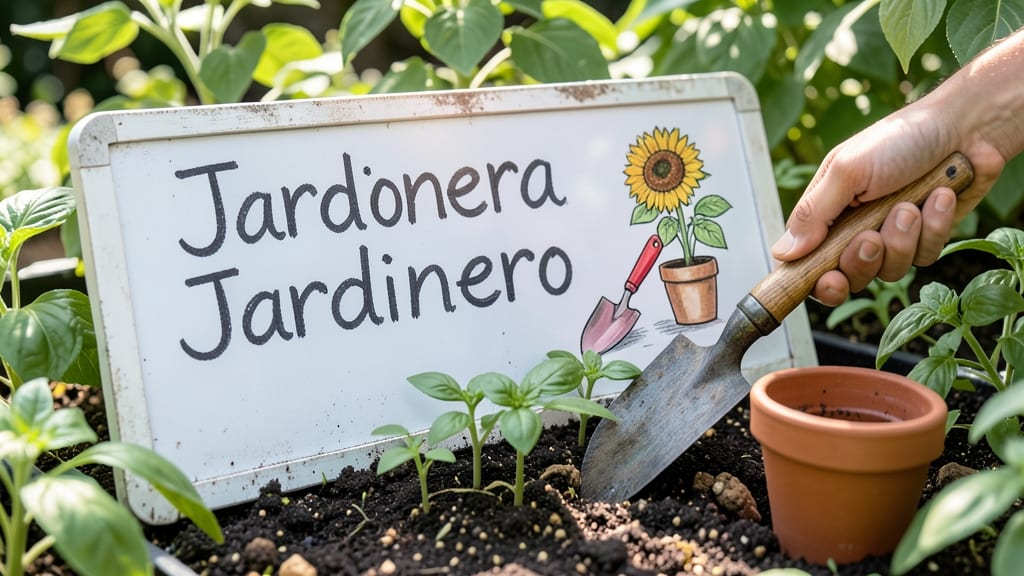
To say 'gardening' in Spanish, use jardineria (pronounced 'hah-ree-dee-NYAY-ah'), which comes from jardin (garden). Other useful terms include cultivar plantas (to cultivate plants) or horticultura (horticulture) for more technical gardening discussions.
Spanish has regional twists that can change the way you talk about plants and soil. 🌱 For example, in Mexico, you might hear huerticultura (pronounced 'wehr-tee-kul-TOO-rah') for vegetable gardening, while in Spain, jardinería (jar-dee-neh-REE-ah) is the standard term.
Even simple words like maceta (flower pot) or riego (irrigation) vary slightly in pronunciation depending on where you are—like the rolled 'r' in riego that trips up non-native speakers.
Beyond just vocabulary, understanding these terms helps you connect with local gardeners or follow instructions in Spanish-language gardening guides. For instance, abono (fertilizer) and compost (compost) are both used, but abono orgánico (organic fertilizer) specifies a natural approach.
The key is listening to how native speakers use these words in context—whether they're talking about jardin (ornamental garden) or huerta (vegetable garden).
💡 In This Article
- Spanish Gardening Vocabulary Beyond 'Jardineria'
- Pronunciation Tips for Spanish Gardening Terms
Spanish gardening vocabulary beyond 'jardineria'
Spanish-speaking regions have distinct terms for gardening that go far beyond just jardineria. For instance, in Mexico, huerticultura (pronounced 'wehr-tee-kul-TOO-rah') refers specifically to vegetable gardening, while jardineria covers ornamental plants.
In Spain, jardinería (jar-dee-neh-REE-ah) is the standard term, but huertanería (wehr-tah-neh-REE-ah) describes small-scale food gardens. These differences reflect cultural priorities—ornamental gardens in Europe versus subsistence farming in Latin America.
Everyday gardening tools and practices also have unique names. A maceta (mah-SEH-tah) is a flower pot, but in some regions, you might hear jarrón (hah-RON) for decorative pots or cubeta (koo-BEH-tah) for larger containers. Irrigation systems are called riego (REE-go), with a rolled 'r' that can be tricky for learners.
Meanwhile, abono (ah-BO-no) means fertilizer, but compost (kom-POST) is also widely used—though abono orgánico (ah-BO-no or-GAH-nee-ko) specifies organic matter.
Context matters when choosing terms. A jardin (hah-REEN) is an ornamental garden, while a huerta (WEHR-tah) is a vegetable plot. In Colombia, cultivo (kul-TEE-vo) means cultivation, but sembrar (sem-BRAHR) refers to planting seeds specifically.
These distinctions help you communicate precisely with local gardeners or follow instructions in Spanish gardening manuals. For example, asking for semillas de tomate (tomato seeds) is clearer than just saying plantas (plants).
Regional dialects add another layer. In Argentina, you might hear floricultura (flor-ee-kul-TOO-rah) for flower gardening, while in Peru, agricultura (ah-gree-kul-TOO-rah) encompasses broader farming. Even weather-related terms vary—lluvia (LYOO-vee-ah) means rain, but riego por goteo (REE-go por goh-TEH-oh) specifies drip irrigation.
These nuances show how gardening language evolves with local climate and traditions.
For practical use, focus on these core terms: maceta (pot), riego (irrigation), abono (fertilizer), cultivar (to cultivate), and poda (pruning). Mastering these will let you discuss gardening confidently, whether you're buying seeds (semillas) or troubleshooting pests (plagas).
The key is listening to how native speakers use these words in context—whether they're talking about jardin (ornamental) or huerta (vegetable).
Pro tip: In Spanish-speaking countries, gardening guides often use técnicas de jardinería (jar-dee-neh-REE-ah) for general methods, while agricultura (ah-gree-kul-TOO-rah) covers larger-scale farming. Knowing these distinctions helps you navigate both backyard projects and professional discussions.